How to Find a Tattoo Artist in Prague and Not Regret It in 5 Years
Technically good work is done almost everywhere in Prague today. But in five years, you won't regret the technique — you'll regret the artist who never asked a single question. Here are the criteria nobody in a studio will tell you.
In brief
- A good artist is a mentor, not a printer: they ask questions and know how to say no with reasoning.
- Overly small lettering and details blur over time and prevent future large-scale work.
- Look at the artist's thinking — not just a polished portfolio shot.
- At the consultation, ask how the tattoo will look in 5 years and how it'll sit on your anatomy.
- Consultation is free and no-obligation — at the studio near I. P. Pavlova metro (Praha 2). Consultations in English.
Back in 2022, I was on the other side of the table. I wasn't an artist yet, I didn't know the industry from the inside — but I desperately wanted a tattoo. My understanding of the process was limited to a simple illusion: you walk into a tattoo studio in Prague, show any picture from the internet, they make you a coffee, and the artist transfers it to your skin in a couple of hours. I assumed every artist was a universal soldier — equally capable of realism, graphic work, and micro-lettering.
But reality turned out to be harsher.
The Assembly Line vs. Individuality: The Other Side of Prague Studios
Tattoo studios are a business first and foremost. When you arrive with a ready-made design, a high-volume studio often doesn't care what's on it. "Let's go, sit down." Of course, Prague has many great studios with artists who have 10–15 years of experience and rock-solid technique. But in a high-throughput environment, tattooing becomes an assembly line.
Back then, as a newcomer, I didn't know the most important things. And no one told me:
- That overly small lettering will inevitably blur over the years and turn into an unreadable mess — due to the natural processes in the skin.
- That by loading your body with lots of small details, you become a prisoner of that style. If you ever want a large, striking piece in the future — say, a sleeve — those small spots will break up the composition and ruin the overall picture.
Technically the work was done well. The lines held. But when I became an artist myself, I made myself a promise: I will never work on an assembly line. My job is to make sure the client doesn't regret their tattoo years later.
That's why I only work by appointment — at a studio near I. P. Pavlova metro (Praha 2, Vinohrady). I always conduct consultations in English: too much meaning gets lost in translation otherwise.
If an artist agrees to any idea you bring without a single question — run.
Look for Someone Who Can Say No
A good specialist always acts as a mentor, not an executor. A client recently came to me wanting a large composition on his chest — the victory of Archangel Michael over Lucifer — and showed me a vertical reference image.
I looked and said plainly: "Look, this composition is purely vertical. If we stretch it across the wide plane of the chest, it'll distort completely. In motion it'll look wrong. Let's think differently."
We moved the project to the arm. In the end, the vertical narrative perfectly accentuated the muscle anatomy, and the tattoo came alive in motion. An artist must see your body as an architectural object, where form dictates the rules.
Work with Meaning, Not Copied Clichés
The second important point is the artist's ability to step beyond the obvious. In that same Lucifer project, the client initially wanted to add the standard set: a tail, horns, hooves. Well, he's a demon — it's all logical.
I could have quietly agreed and done it. But I didn't want to make a tasteless cliché. We started discussing. I asked: "What are we actually trying to show? A pop-culture devil or the moment of tragedy and the fall?"
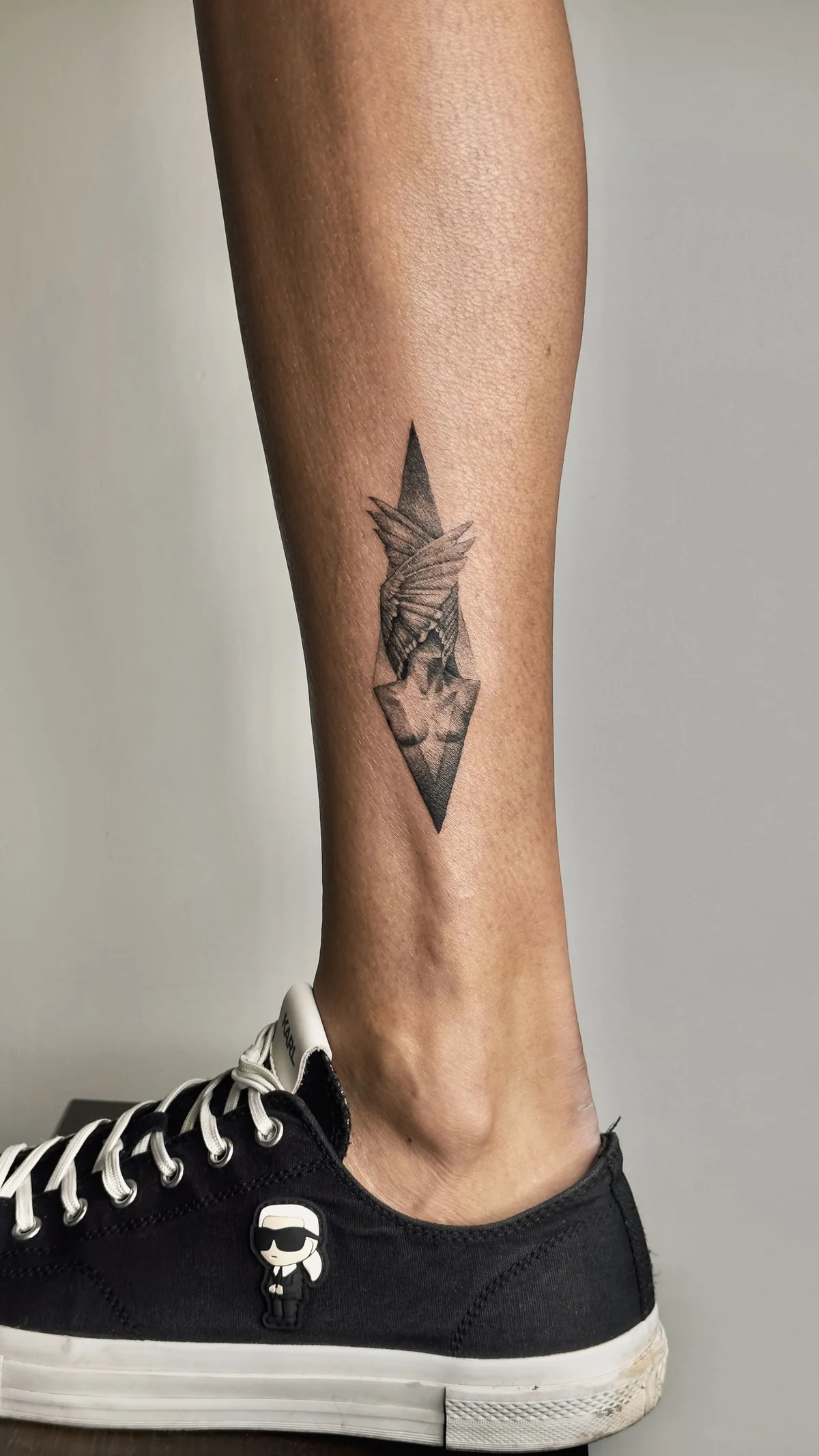
Through the conversation, a powerful idea emerged: drop the horns and tail, but add wings. Not just wings — show the transformation itself: one wing remained angelic, bright, while the other was already turning demonic. This is the moment of transition from the beautiful to the terrible.
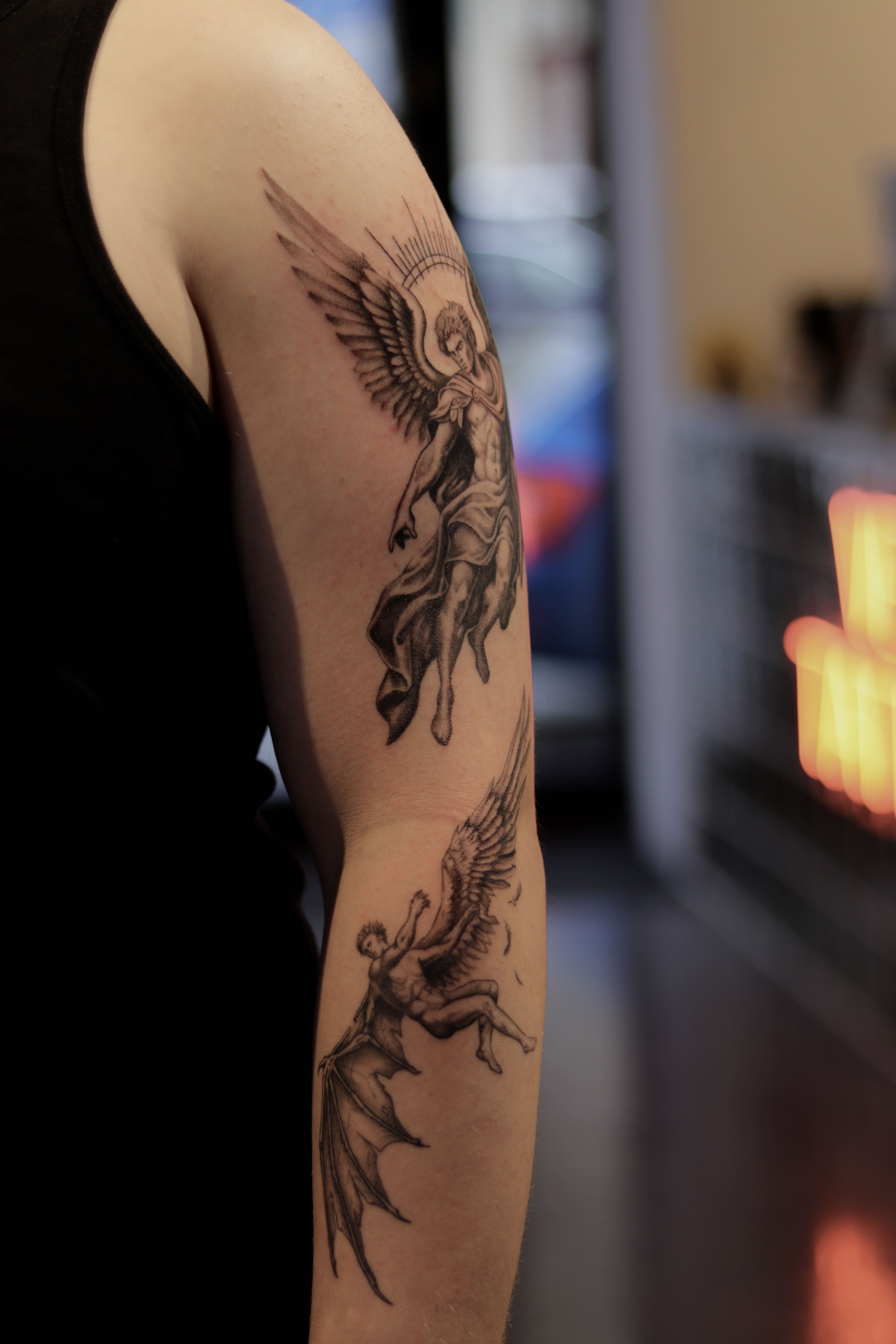
The tattoo gained a philosophy understood only by its owner — that's exactly the difference between a craftsman and a co-author.
Look at Their Thinking, Not Their Portfolio
Let's be honest: Prague has a huge number of excellent tattoo artists today. The industry has moved forward, and producing technically quality work is now just the baseline. But behind perfect, polished photos on social media there's often a faceless quality. You're looking at a skilled copier.
If you want truly memorable work, don't look at the final shot with perfect lighting. Look at the artist's thinking:
Even if an artist doesn't show their face in the frame, their content should make it clear how their mind works. Finding someone whose vision and depth of perception align with yours matters far more than a "printer" who mechanically copies an outline onto skin.
What to Ask a Tattoo Artist in Prague at a Consultation
Don't be shy about asking questions. Three that will immediately reveal an artist's level:
- How will this tattoo look in 5 years?
- How will it sit on my muscles and anatomy?
- What could be improved in the design?
If you hear a reasoned opinion backed by experience and compositional understanding — you've found your artist.
Want to test these criteria in practice? Book a free consultation →
Studio near I. P. Pavlova metro, Praha 2. Work from 2,500 CZK. Consultations in English.
Already tattooed and wondering what comes next? Healing day by day is covered in Tattoo aftercare: a complete guide. What it costs is here.