Statue tattoos: how classical marble translates to skin
A statue on skin looks simple until you try to draw one: marble has no lines at all, only light and shadow. Here is how to choose the sculpture, what size and placement it needs, and what happens to it over ten years.
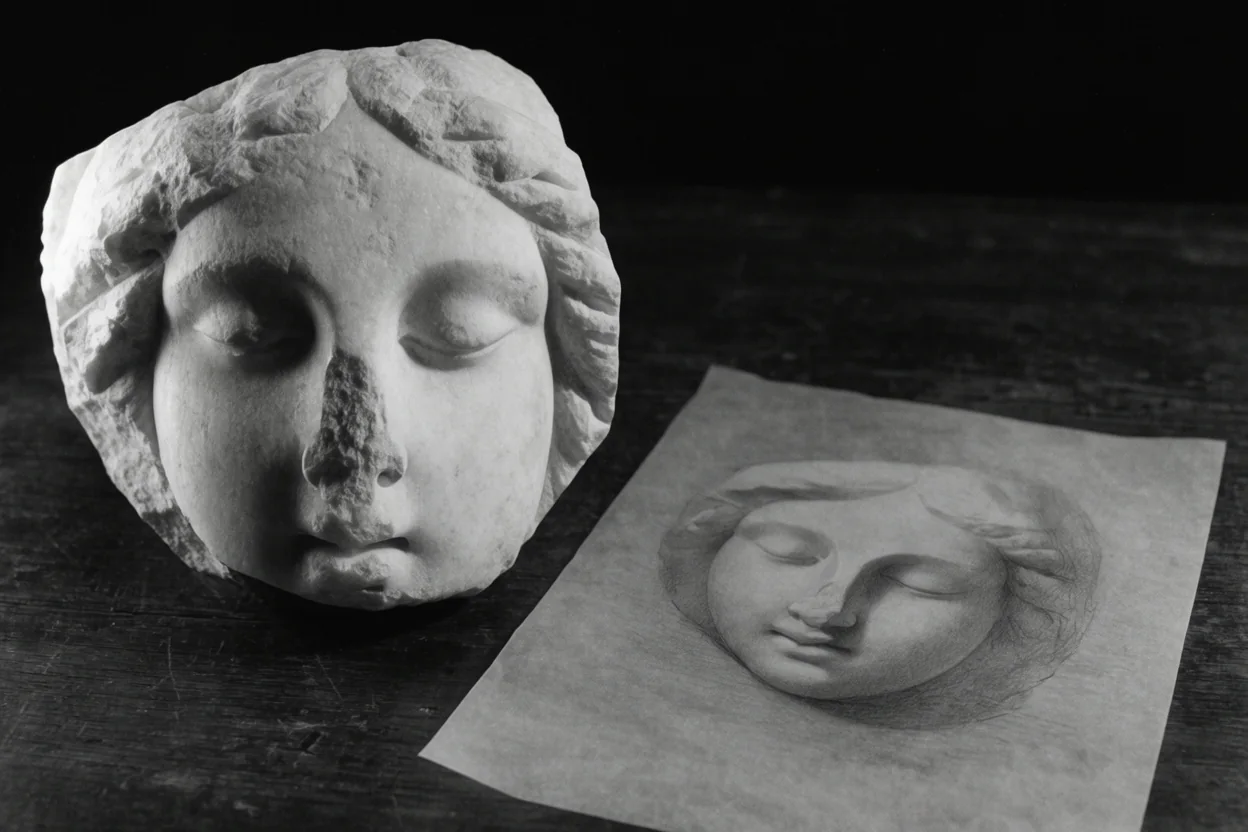
In short
- Sculpture is done in black & grey: the shape is held by shading, not by an outline.
- A statue’s face needs at least 10–12 cm, a full figure 15–20 cm. Only a fragment can go smaller: a hand, a wing, a fold of drapery.
- It works best on an even muscle: outer forearm, shoulder, calf, thigh, back.
- Over ten years the lightest greys fade first, so the deep black is planned into the sketch from the start.
- Take your reference from a photo of the statue itself in side light, not from someone else’s tattoo.
Classical sculpture, angels and mythology are what I keep coming back to. My work in this style is on the page about black & grey in Prague.
Below is what separates a good statue on skin from a grey smudge, and how to prepare if you want a piece like that.
Why sculpture works on skin
A statue already has everything a tattoo needs: volume, a readable silhouette and the light the sculptor built into the form. Marble is monochrome to begin with, so it loses nothing in black & grey and has no need for colour.
Second, sculpture is calm. A statue’s face doesn’t depend on fashion, hair or make-up, so twenty years later the piece doesn’t look tied to the year it was made.
Third, sculpture carries a story. An angel, Medusa, Atlas, a pair of marble hands: people rarely choose them for looks alone. There is usually a story behind the choice, and it can be built into the composition.
The hard part: marble has no outline
When you draw a person, you lean on lines: the edge of the nose, the lips, an eyelid. A marble head has none of them. The edge of a cheek only exists because one side is lit and the other is in shadow.
That is why a statue can’t be outlined and filled in. It has to be rebuilt out of shadow and half-tone on a patch of skin the size of a postcard, knowing it still has to read in twenty years once the pigment has spread a little.
In practice that means three things:
- The outline is either very thin or not there at all. The shape is held by the contrast between light and shadow.
- The light is set once, as in a museum: from one side. When shadows fall from different directions, the statue turns into a flat smudge.
- The deepest black goes into the sketch right away. Without it, everything merges into one grey within a few years.
Which sculpture to choose
Almost any statue can go on skin, but different subjects need different sizes and placements.
- A head or bust. The most common request and the most expressive. The face is the point, so size decides everything.
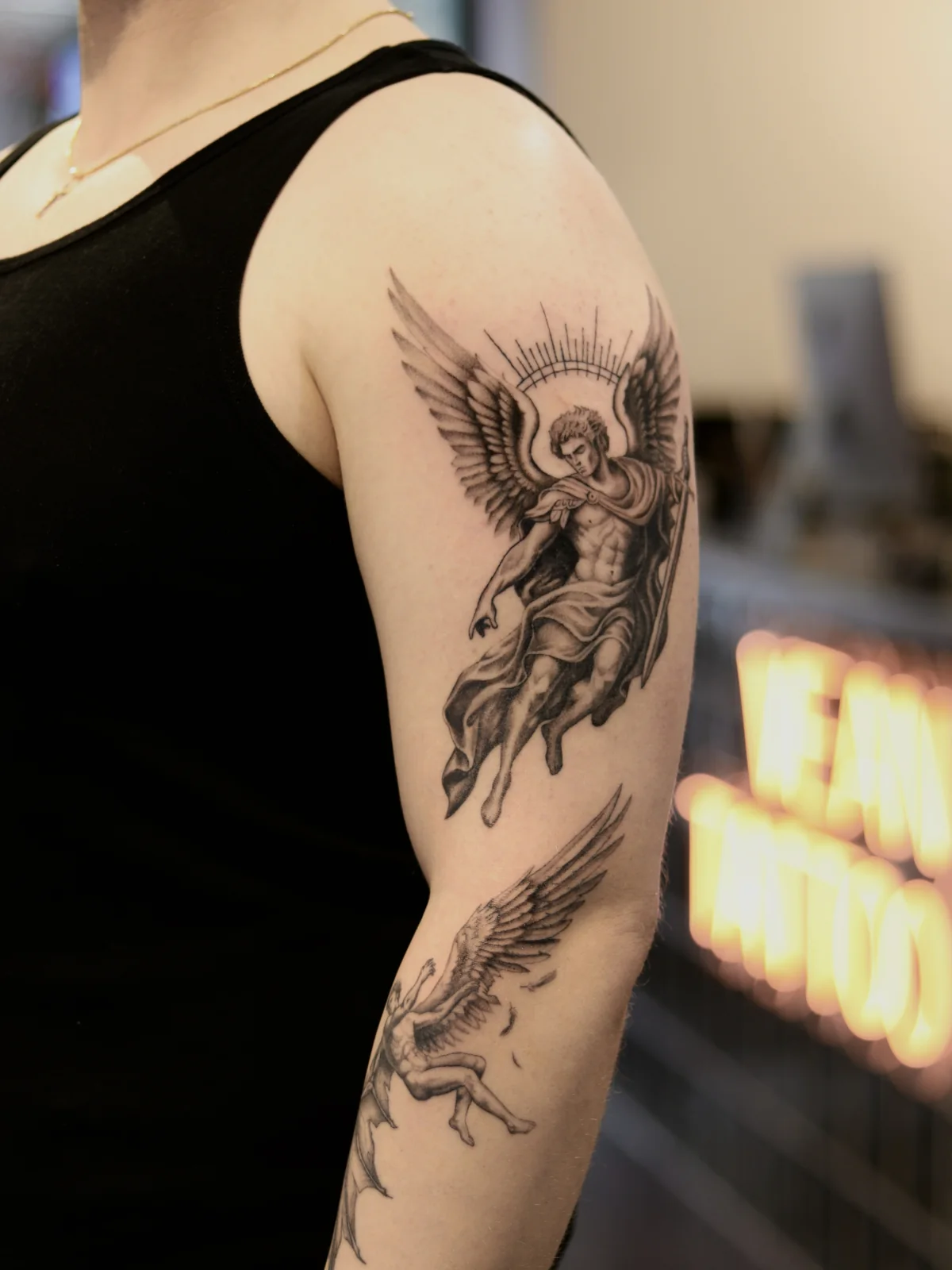
- A full figure. An angel, Nike, Atlas. It needs a long area: forearm, shin, side, back.
- A fragment. Marble hands, a wing, a fold of drapery. It can be smaller and fit between tattoos you already have.
- A scene. Cupid and Psyche, the fall of Lucifer, Archangel Michael. Two or more figures always make a large piece, often over several sessions.
I talk through mythological subjects with each person separately. For one person Medusa is protection, for another she stands for something they survived, and that changes how she looks and where her gaze goes.
Size and placement
Sculpture has a higher minimum size than any line work, and the reason is the face: the eyes, nostrils and corners of the mouth have to stay separate details instead of merging into a dot.
- Head or bust: from 10–12 cm tall.
- Full figure: from 15–20 cm, otherwise the face ends up the size of a fingernail.
- A fragment without a face (hand, wing, fabric): from 6–8 cm, in microrealism.
Placement follows the muscle. A statue stands, turns and leans, and its axis should line up with the axis of the arm or leg. The outer forearm, shoulder, calf, thigh and back give an even surface and hold shading well. Hands, fingers and wrists are a poor choice for sculpture: the skin renews quickly there and the half-tones are gone within a couple of years.
How a piece like this ages
Black & grey ages by losing contrast. The lightest greys go first and the dense black stays. If there is no real black in the piece, ten years on it will be an even grey.
So the sketch plans at least three tones: deep shadow, a middle half-tone and bare skin where the light falls. Detail inside the light areas is kept to a minimum, because anything smaller than a millimetre dissolves over time.
Sun speeds up fading more than anything else. SPF on an exposed piece in summer is the only aftercare that genuinely extends its life.
What reference to bring
The best reference is a photo of the statue itself, not someone’s tattoo of it. A tattoo has already been through another artist’s decisions, and a copy of a copy always loses the form.
- A photo in side light, which shows the volume. A front-on museum flash flattens the marble.
- Two or three angles of the same sculpture, if you have them.
- If the idea combines several statues, send everything you like and we will sort it out at the consultation.
- And tell me what it means to you. Sometimes that is what decides the composition, as in the “Love / Truth” case study.
I draw the sketch around your anatomy and show it to you before the session. It usually takes three to seven days.
What it costs and how long it takes
A statue is almost never a small piece. A medium piece starts at 5,000 Kč and takes about three hours; a large one starts at 7,500 Kč. A full-length figure or a scene is usually split over several sessions, so the skin can rest and the shading goes in evenly.
I give the exact price after a free consultation, once the size and detail are clear. What goes into the price is in the pricing article.
Ready-made designs with sculpture, angels and mythology are on the flash page. How a style is chosen for a motif is in the article on fine line and black & grey.