Fine line vs black & grey: how to choose a tattoo style
Half the people who come to me arrive with a word ready, the other half with a picture. The name of a style decides little: the motif, the size, the placement and how the piece will look in ten years matter more.
In short
- Fine line is thin lines and minimal shading. Black & grey is volume, shading and gradients without colour.
- The motif decides first: a symbol, lettering or a botanical piece is fine line; a sculpture, a face or fabric is black & grey.
- Size decides second: fine line lives from 3 cm, black & grey opens up from 10 cm.
- After ten years thin lines soften and spread a little, shading loses some contrast. Both age fine if they were made with margin.
- Combining them is possible and often right: outline in a thin line, volume in shading. That is how I do most of my work.
Half the people who come to me arrive with a word ready: "I want fine line" or "I want realism". The other half arrive with a picture and do not know what it is called. Both are fine, because a style is not chosen by its name but by the motif, the size, the placement and how the piece will look in ten years. If you already know which of the two you want, there is a page for each: fine line in Prague and black & grey in Prague, with sizes, prices and examples.
Here is how the styles differ in practice, and the four questions that make the choice obvious.
What fine line is and what black & grey is
Fine line is work with thin needles, one or three. Lines around half a millimetre, minimal fill, shading light if there is any. A style about precision and air: botanicals, lettering, outlined figures, symbols, small scenes. Sessions are short and the skin takes little damage.
Black & grey is realism without colour. Volume is built with shading: from solid black to a barely visible grey. A style about depth and material: marble, fabric, skin, a face, light. Sessions are longer and the area is bigger.
Microrealism sits between them: realistic volume at a small size. The most demanding of the three, because the margin for error and for ageing is minimal.
I do not do colour at all, so everything below is about black.
First question: what is the motif
The motif almost always picks the style itself.
- A symbol, a sign, lettering, botanicals, geometry: fine line. The line matters here, not volume, and shading only gets in the way.
- A sculpture, an angel, a face, a hand, fabric, an animal: black & grey. These are objects with volume, and without shading they turn into a colouring book.
- A mythological scene, a portrait at a small size: microrealism or a combination, and that is a conversation for the consultation.
Antique sculpture, which I work with most often, nearly always lives in black & grey: folds, marble, light on a shoulder cannot be drawn with a single line. But the outline of the same sculpture in a thin line is already fine line, and that can be beautiful too if the motif is simple.
Second question: size and placement
Each technique has a minimum size below which the work stops reading.
Fine line lives from 3–4 cm. Smaller, and in five years the lines merge into a blot. Black & grey opens up from 10 cm: shading needs area for a transition from black to grey rather than two steps.
Placement adds its own rules. Fingers, hands, feet and the inside of the wrist are zones where the skin renews quickly and rubs; every technique suffers there, but fine line faster. Forearm, upper arm, thigh, back: where everything holds well.
The practical conclusion: a small piece somewhere visible is fine line on the forearm. A large piece with volume is black & grey from the upper arm up, or on the thigh.
Third question: how it looks in ten years
Every tattoo changes over time. Pigment under the skin spreads slightly, lines get softer, contrast drops. Every style ages, so what matters is whether the piece has margin.
Fine line ages by lines spreading. A thin line is about half again as wide and softer after ten years. If there was air between the lines, the piece stays readable. If the lines sat right next to each other, they merge. That is why I never make fine line "smaller than it needs to be".
Black & grey ages by losing contrast: the light greys go first, solid black stays. A piece with real black in it holds its shape for years. A piece made entirely of light grey looks like the shadow of a tattoo after ten years.
Sun speeds up both stories equally. SPF on exposed pieces is the only aftercare that genuinely matters.
Combining them: when that is the right answer
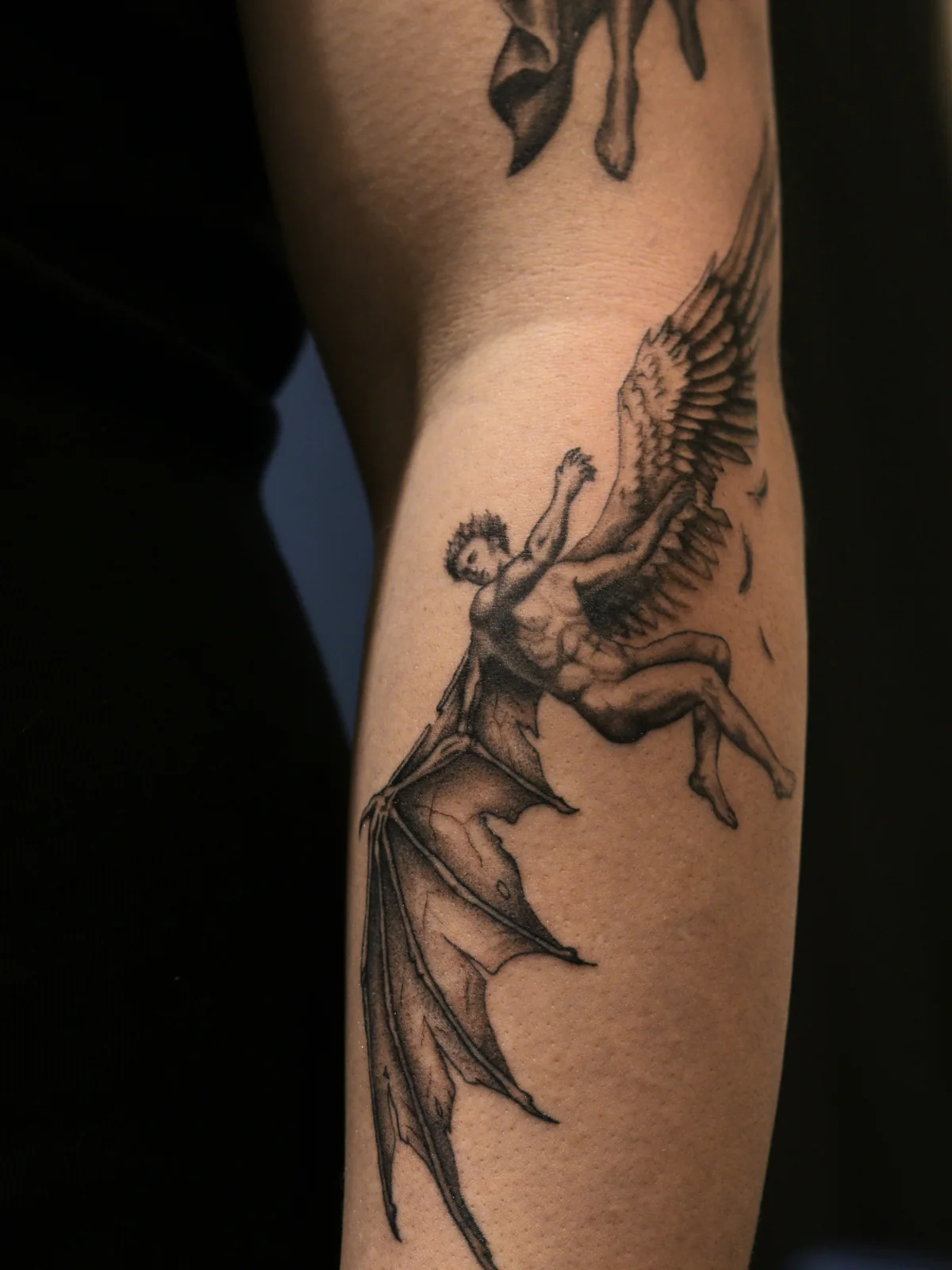
Most of my work is both techniques in one: outline and detail in a thin line, volume in shading. The angel in the photo above is exactly that: the line holds the shape, the shading gives it body. The piece gets the precision of fine line and the depth of realism.
Combining is not for every motif. A simple symbol only gets heavier with shading, and dense realism does not need a thin outline. But for sculpture, figures and mythology it is the right answer more often than not.
How to decide
- Start with the motif, not the style. Bring a picture, a reference, a description, anything.
- Decide the size honestly. If you want something small, it is fine line. If you want volume, you will have to give it area.
- Think about placement in terms of how it ages, not just how it looks in the mirror.
- The rest happens at the consultation. I will tell you what will work and what will look different in five years from what you want.
What to ask any artist before booking, and how to tell a conveyor-belt studio from someone who runs the piece from start to finish, is in a separate article. What each option costs is here.
Worried about pain? I have mapped where it is bearable and where it is not in the article on pain. How to look after a fresh piece is here.