Arm tattoo placement: which spot to choose and what lasts there
The arm is the most requested place for a tattoo, but the skin on it changes a lot between the shoulder and the fingertips. I go through it spot by spot: how each one holds a design, how much it hurts, what size it needs and what it costs.
In short
- The outer forearm and the outer upper arm hold a design best and hurt least, 2–4 out of 10. For a first tattoo they are the safest choice.
- The inner wrist, the hand and the fingers bend, rub and get washed all day. Thin lines there spread within a couple of years.
- Fine line on the arm needs at least 3–4 cm, black & grey realism at least 10 cm. A face or a statue belongs on the forearm or the upper arm.
- The forearm has a tall narrow format, the upper arm a wide rounded one. Long motifs sit better on the forearm, wide ones on the upper arm.
- A small piece up to 5x5 cm starts at 2,500 CZK, a medium one of 10–15 cm at 5,000 CZK, a large one from 15 cm at 7,500 CZK. A sleeve can be done in stages.
In the Czech Republic people google arm tattoos about six times more often than leg tattoos. I can see why: you and everyone else can see your arm, and a long sleeve hides it when needed. But "arm" covers everything from the shoulder to the fingertips, and the skin on a forearm is nothing like the skin on a wrist.
I start with the forearm, because that is where most people start, move down to the hand and fingers, and then come back up to the elbow and upper arm. For each spot I say how big a piece has to be to still read in ten years, and I point out the ones I would not pick for a first tattoo.
The arm at a glance
Pain is on a 1–10 scale. The numbers hold for most people, though everyone has a different threshold.
| Spot | Pain | How a design holds | What suits it |
|---|---|---|---|
| Outer forearm | 2–4 | Very well | Fine line from 3–4 cm, realism from 10 cm, tall compositions |
| Inner forearm | 4–6 | Well | Delicate linework, lettering, pieces meant for you |
| Wrist | 4–6, more at the crease | Worse, lines spread | Simple motifs only, with air between the lines |
| Hand and fingers | 6–8 | Worst, pigment drops out | Simple bolder shapes, expect touch-ups |
| Elbow and elbow ditch | 6–8 | Fair, heals slowly | Usually only as part of a sleeve |
| Outer upper arm and shoulder | 2–4 | Best on the whole arm | Black & grey with volume, statues, faces, large pieces |
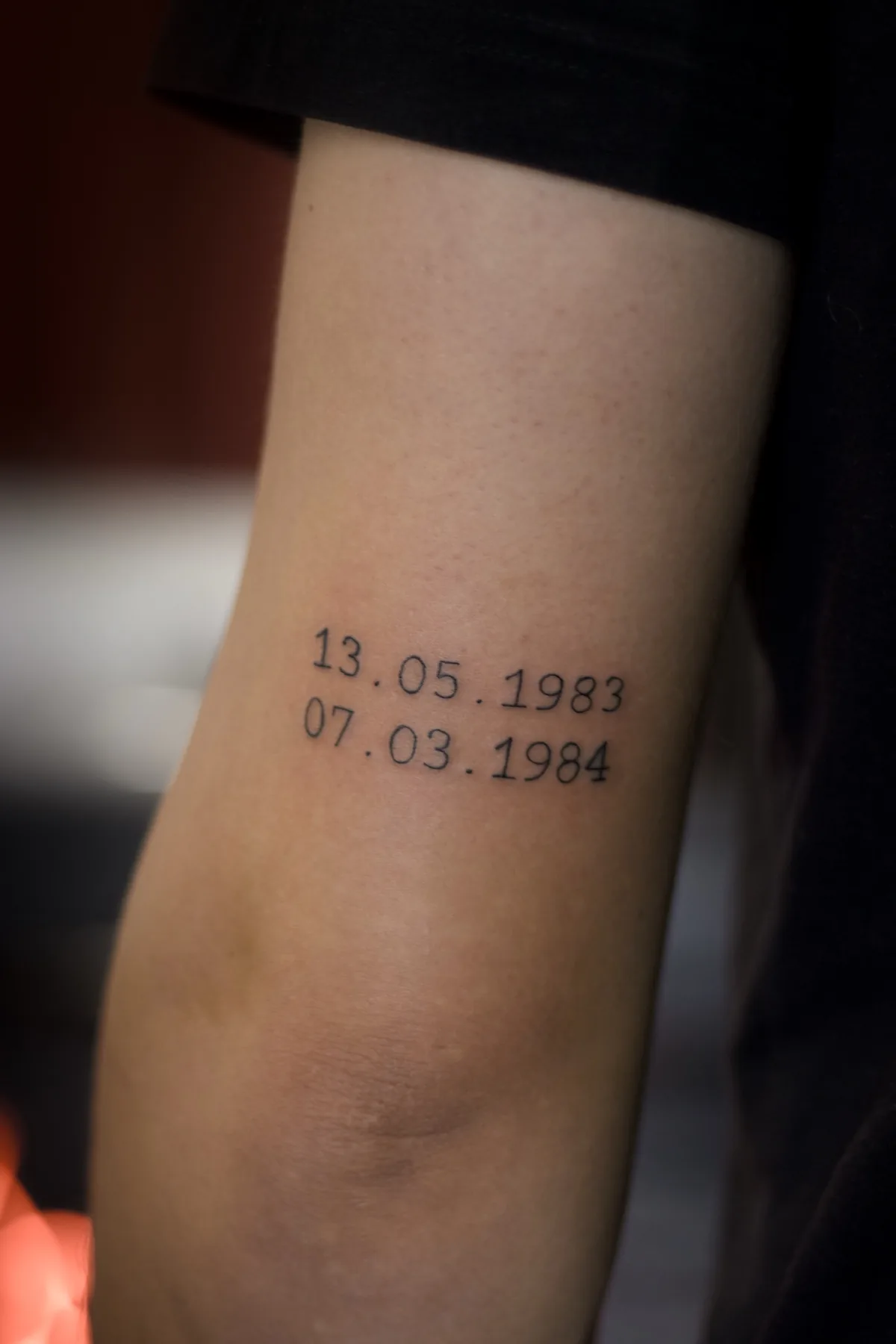
| Inner upper arm (bicep) | 4–6 | Well | Medium pieces, text, designs kept out of sight |
Forearm tattoos
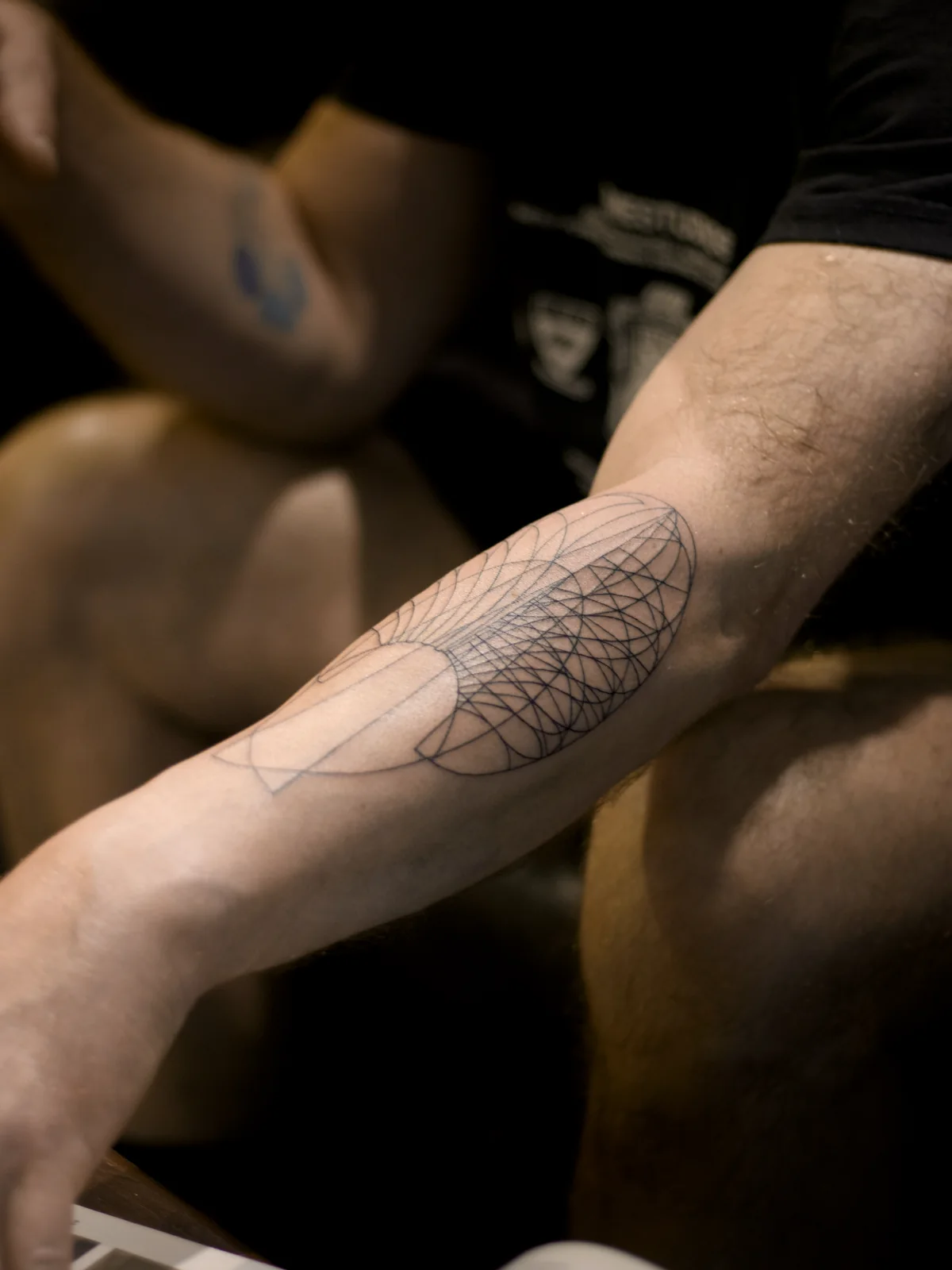
If I had to pick one place on the arm, it would be the outer forearm. The muscle is flat, the skin is firm and the bone is far away, so the session is one of the calmer ones and lines hold well. It is a tall narrow format: a figure, a statue, a flower on a stem, vertical lettering or geometry all sit well on it.
The inner forearm is more sensitive, roughly 4–6 out of 10, and the skin is thinner and paler. A design looks softer there and you are the one who sees it most. People often put pieces here that carry a personal meaning and do not need an audience.
Fine line works on the forearm from 3–4 cm, and a smaller motif merges into a blot within five years. Shaded realism opens up from 10 cm, and the face of a statue needs 10–12 cm in height. A full figure from 15 cm takes up most of the forearm and is comfortable there, since the long format suits a standing figure.
The forearm shows in a T-shirt and disappears under a shirt. If work or family is on your mind, it is the least trouble: show it when you want to, put a shirt on when you do not.
Wrist tattoos
People ask for wrist tattoos a lot, and they age worse than almost any other. The inner wrist bends all day, the skin is thin, and a watch strap or a cuff keeps rubbing against it. A thin line in a place like that spreads within a couple of years.
If you want one anyway, I would move the motif three or four centimetres up from the crease toward the forearm and pick a simple shape with air between the lines. I would not go under 3–4 cm, even though the spot invites something tiny: overly small lettering blurs and stops being readable, and the wrist is where that happens fastest. If an idea will not hold up for five years in that spot, I will probably try to talk you out of it.
Hand and finger tattoos
Hands and fingers have the hardest skin on the whole arm. They hurt more, 6–8 out of 10, because bone and tendons lie right under the skin. Pigment holds worse too: the skin here renews faster than elsewhere, you wash it all the time and it is almost always in the sun.
A finger tattoo therefore comes with touch-ups and with crisp edges going soft. Pigment drops out most on the side of the finger and on the palm. For a small piece somewhere visible I would suggest moving it to the forearm, where it will last noticeably longer.
You also cannot hide your hands at a job interview or at your grandmother's table. For a first tattoo, a spot where you decide when it shows is the better choice.
Elbow and elbow ditch
The elbow is bone under thin, mobile skin. The session goes slowly, pain is 6–8 out of 10, and healing takes longer because you bend your arm a hundred times a day. The elbow ditch on the inside is about as sensitive, and the skin there is even finer. A standalone motif on the elbow is rare. Most people get to it when a sleeve is coming together and the forearm has to be joined to the upper arm, and the composition then either goes around the fold or makes it the centre.
Upper arm and shoulder tattoos
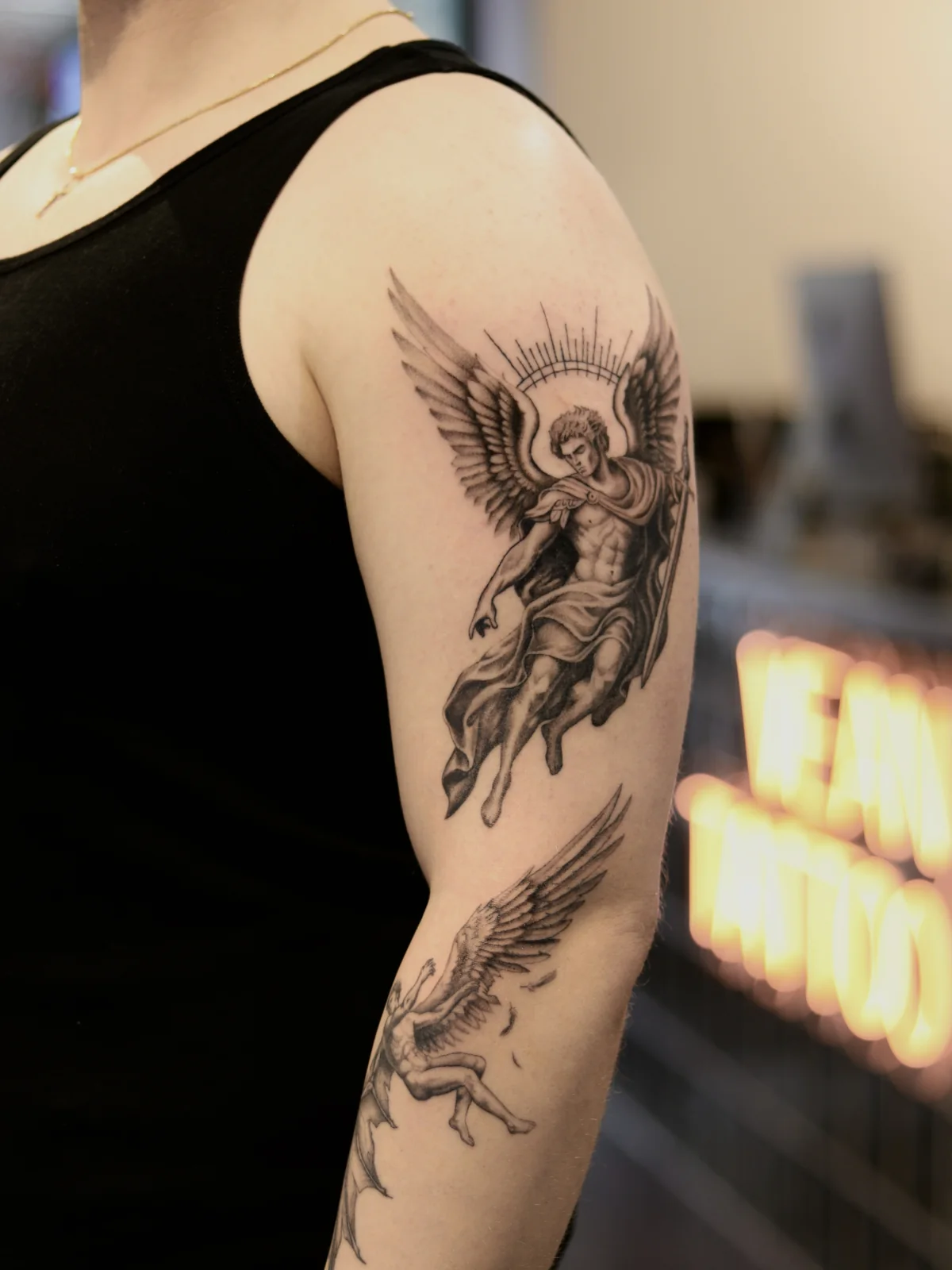
The outer upper arm and the shoulder are the easiest area on the whole arm to work with. There is plenty of muscle, the skin is firm and pain stays at the same 2–4 out of 10 as on the forearm. A T-shirt covers it from the sun most of the year, which is why a tattoo ages slowest here.
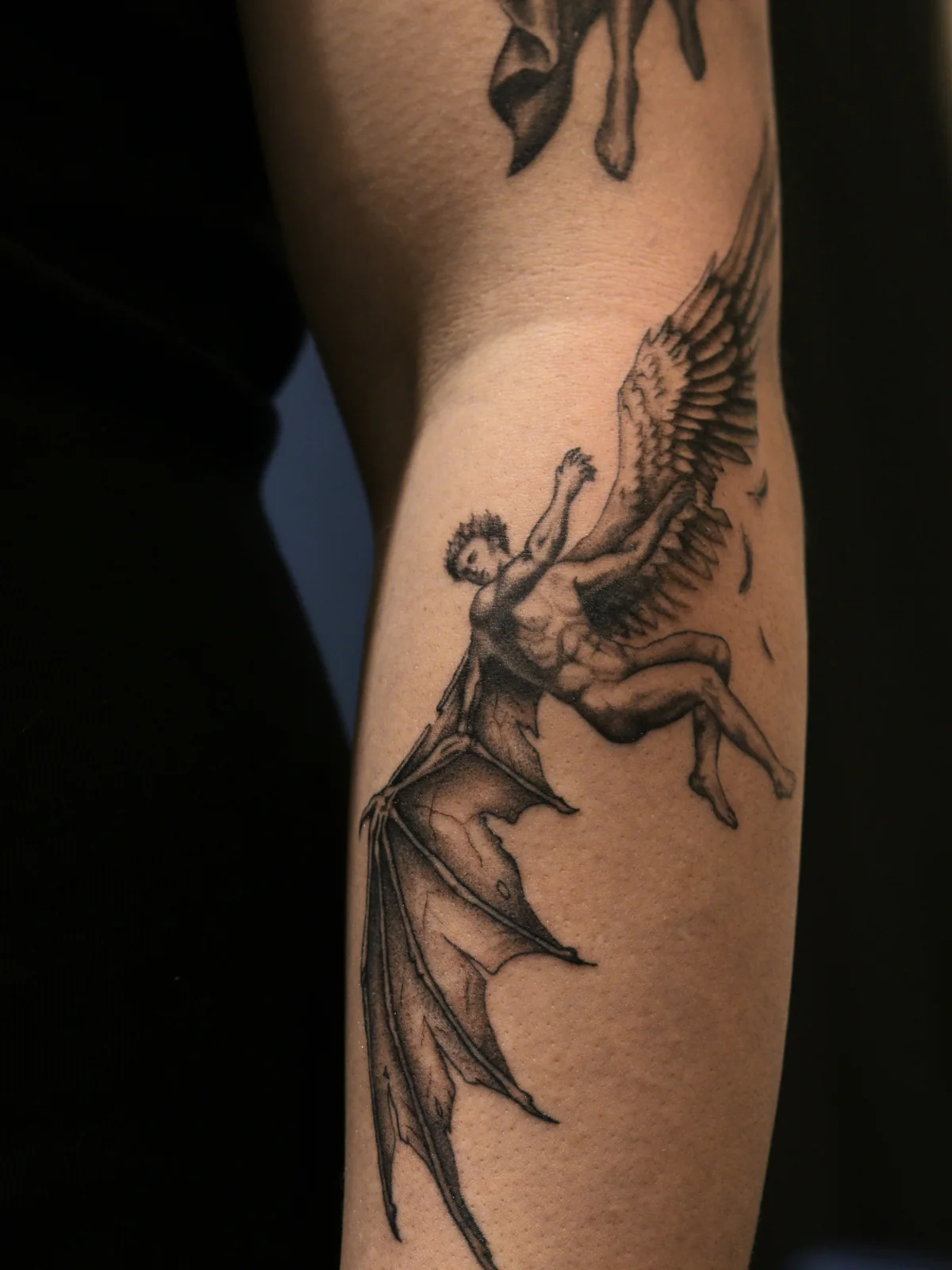
The format is wider and rounded, so this is where pieces with volume go: a statue, a face, an angel, fabric. Black & grey needs area for the move from black to grey to come out smooth, and here it has that area. The inner upper arm by the bicep is more sensitive, 4–6 out of 10, and suits medium pieces that are not meant to be on show.
Why a design is drawn for one particular arm
The arm moves all the time, and the design moves with it. The forearm twists when you turn your palm, so a straight line running the whole length of it is straight in one position only. A circle on the bicep turns into an oval when you flex.
That is why I draw a design for one particular arm: long motifs run along the arm, and a face or any other important detail stays away from places where the skin bunches up in motion. We choose the final size and the exact position on the day of the session: I try several stencil variants on your arm, and we start when both of us are happy.
If you might want a sleeve one day
A sleeve is worth a thought before your first tattoo, even if it seems like too much right now. Five small motifs scattered over the forearm each look good on their own, but later there is nowhere to put a bigger piece, and they will not add up to a sleeve.
If a sleeve appeals to you even a little, start with one larger piece on the outer forearm or the upper arm and leave space around it. A sleeve is then done in stages, months apart if you like, and you pay for each stage separately.
Women's and men's arm tattoos
For a tattoo there is no such thing as women's skin or men's skin, so the split is a loose one. What usually stands behind those search words is a difference in scale and line weight. A "delicate" or "elegant" arm tattoo usually means fine line: a thin line, little shading, a motif along the axis of the forearm and plenty of bare skin around it. "For men" usually means larger black & grey with volume on the outer forearm or the upper arm.
Anyone can wear either. What matters more is that the size fits the technique: a thin line under 3 cm spreads on any arm.
How much an arm tattoo costs
Size and density of detail set the price, and the spot on the arm changes it only a little. A small piece up to 5x5 cm starts at 2,500 CZK and takes about an hour. The typical forearm tattoo is a medium piece of 10–15 cm: from 5,000 CZK and around three hours. Anything over 15 cm starts at 7,500 CZK and takes five hours or more.
The elbow and the inner upper arm come out slightly higher, because the skin is thinner and more mobile and the work goes slower. I quote a price for the whole piece up front and do not charge by the hour. The details are in How much a tattoo costs in Prague.
How an arm tattoo heals
An arm heals well because you can see it and reach it. The healing film stays on for 3–5 days, then for 10–14 days you wash the tattoo and apply a thin layer of cream. The surface is healed in two weeks, the deeper layers in 4–6 weeks. The full routine is in Tattoo aftercare: healing day by day.
A few things apply to the arm in particular. A fresh tattoo should not sit under a tight sleeve, a watch strap or a bracelet. The gym can wait 3–5 days, because flexing the muscle stops the edges from healing evenly. In summer the forearm is in the sun almost all the time, so SPF 50 on a healed piece is especially needed here. Where it hurts across the whole body is on the pain map.
Not sure whether fine line or black & grey fits your motif? The difference is in the article on styles. Each style also has its own page: fine line in Prague and black & grey in Prague.